Procedure

  • Subscribe to our RSS feed.
  • Twitter
  • StumbleUpon
  • Reddit
  • Facebook
  • Digg

Friday, December 7, 2012

Another Apple touch-screen patent in trouble

Posted on 9:14 PM by Unknown

One of Apple's broad patents covering touch-screen technology is under fire by the U.S. Patent and Trademark Office, following a re-examination.
The USPTO ruled this week that all 20 claims included in the patent are invalid, according to a filing spotted by blog Foss Patents.
The decision, which was handed down Monday, is not final.
It's the second such Apple patent to be deemed completely invalid following a re-examination by the USPTO. A similar decision for an Apple patent covering the company's rubber-banding bounce effect came in late October, and is also subject to an appeal.
Of note, late Apple co-founder Steve Jobs is listed as the chief inventor, along with 24 others, of the touch-related technology listed in U.S. Patent No. 7,479,949. The company filed for the patent in April 2008, and was granted it just nine months later. It was one of three used against Motorola in a recent patent suit, which was tossed out of court last month.
Smack that screen.
Source
Read More
Posted in | No comments

Thursday, December 6, 2012

Beyond quad-core: What's next for mobile processing power

Posted on 4:44 PM by Unknown

Remember when a quad-core processor was the ultimate indicator of a super-smartphone? Well its 15 minutes are almost up.
Just as the current run of super-smartphones are destined for the bargain bin in a few months, so too will the novelty and obsession with the number of cores powering a phone begin to fade. Sure, smartphones with the latest quad-core chips still rule now, but companies are already preparing to change the conversation.
In its place, expect chip companies, handset manufacturers, and wireless carriers to shift their marketing away from an emphasis cores and more toward tangible benefits such as a smoother experience, bigger displays with higher-resolution graphics, and better battery life.
"That's the end game for a lot of these semiconductor companies: connect great experiences and long battery life with their chip," said Francis Sideco, an analyst at IHS.
The mobile industry has been making steady progress on the brains found in smartphones. It wasn't that long ago that a 1-gigahertz processor was the high benchmark for a mobile device. Then came the advent of dual-core processors, and this year brought quad-core chips to the mainstream.
The progression made for an easy marketing message to consumers and specification geeks: if two cores are better than one, four has got to be even better. Of course, the truth isn't really that simple, but that doesn't stop everyone in the mobile devices industry, right down to the sales staff, from repeating it as gospel.
The obsession with mobile processors has been a boon to the chip makers, giving added visibility to companies such as Qualcomm and Nvidia. These aren't exactly household names, but they are brands that mean something to gadget enthusiasts, and are often associated with quality. It's no wonder companies such as Qualcomm have spent millions of dollars marketing the Snapdragon processor brand, similar to Intel's own "Intel Inside" campaign for PCs.
But the chip industry is getting to the point where more cores will result in diminishing returns, with most companies agreeing that four will be the limit for a while. That's because few applications and tasks on the phone (or computer) can take advantage of multiple cores and actually get a benefit.
"Quad-core CPUs will have become the standard for mobile devices," said Matt Wuebbling, director of Nvidia's Tegra marketing. "While some may try to move beyond quad-core, we don't believe there will be a perceptible user benefit."
So don't hold your breath for a five or six-core smartphone.
Without the easy sales pitch of more cores, these companies have their work cut out for them when it comes to talking about their chips.
"It's what's keeping their chief marketing officers up at night," Sideco said.

Battery life a focus 
Traditionally, more cores has meant a larger drain on battery life. That has necessitated the creation of larger smartphones with bigger batteries.
In moving beyond cores, the extension of a battery life will be a priority for these companies. Nvidia already talks about its fifth "stealth" core that helps to save battery life, but that's just the beginning.
Future Snapdragon chips will have not only the central CPU cores, but also specialized "blocks" that reduce the strain on the main cores and handle specific tasks such as managing the camera lens or controlling the sensors, according to Raj Talluri, vice president of product management for Qualcomm's CDMA technologies unit.
"We want to make sure that you don't have to charge the phone every day, even if you have that flagship smartphone with the big camera, Wi-Fi, big display, and navigation," he said.
The Droid Razr Maxx HD packs a bigger battery, but as tasks get more complicated, how much bigger can they get?
(Credit: Sarah Tew/CNET)
The company hopes to differentiate itself from the competition by improving the power efficiency of its processor relative to ARM Holding's next version of its ARM processor, which is the model upon which most mobile processors are based on.
The handset manufacturers have attempted to mitigate the power issue with larger batteries, with Google's Motorola Mobility notably pushing its heftier Droid Razr Maxx HD. But the chip makers have a role to play here, Talluri said.
"You can't keep packing in bigger batteries because people are used to thin phones," he said.
Qualcomm was late to the quad-core game, with the LG Optimus G and HTC Droid DNA being the first phones to use its latest chips. But its dual-core processors often ran on par with the competition, already deflating some of the perception of the superiority of more cores.
Better, bolder graphics 
Much like the PC industry got off its push to sell quad-core computers to focus on other features like graphics, the mobile industry should start to hear more noise about improved displays, higher resolutions, and console game-like graphics.
Nvidia, unsurprisingly, has been leading the charge when it comes to the graphics rhetoric. Legions of PC gamers already know about Nvidia, and the company hopes to develop the same kind of reputation on the mobile side.
"In 2013 you'll see the gap between console and mobile games almost disappear," Wuebbling said.
The Droid DNA offers a higher resolution display than the iPhone, but it requires a powerful processor.
(Credit: Sarah Tew/CNET)
The industry is already starting to move towards better, higher resolution displays. One of the new buzzwords is PPI, or pixels per inch. Apple started the trend by focusing on the high PPI found in the iPhone's "Retina Display," and other manufacturers have started to stress the amount of pixels packed into their display. The Droid DNA has 440 PPI, compared with the Retina Display's 326 PPI.
More pixels means the need for a stronger processor to power those visuals, which is where Qualcomm, Nvidia, and others including Texas Instruments and even Intel, come in.
Beyond graphics, Wuebbling said future devices will include better camera capture and editing capabilities. It won't just be photos; shooting and editing video will be much easier and faster than before.
Emotional connection 
The odds are high that the chip companies will succeed in changing the conversation. Tech trends change rapidly, and today's dominant player can be tomorrow's also-ran. Qualcomm, for instance, is the leader in the industry by far with its Snapdragon line of processors, but challengers such as Nvidia have managed to win a place in several high-profile mobile devices.
Intel, which is completely dominant in the PC chip business, can't be dismissed as an eventual competitor in the mobile market. Its Atom processor is already in a variant of the Motorola Razr M, but it has yet to make inroads in mobile devices found in the U.S. market.
But Intel is the company that the others likely look to as the model. Its Intel Inside campaign drilled in the message that its chips meant quality and high performance, and it has soundly dominated PC rival AMD for years.
That's why companies such as Qualcomm are racing to develop that reputation in the mobile world. The company last year struck a deal to temporarily rename the Chargers' football stadium in San Diego to Snapdragon Stadium from Qualcomm Stadium. Next month, Qualcomm CEO Paul Jacobs will take over Microsoft's keynote spot at the Consumer Electronics Show in Las Vegas.
Nvidia, meanwhile, will loudly tout where its chips go into, and talk more about the capabilities rather than horsepower, all in an effort to get consumers to remember its brand.
"It's not necessarily a speeds and feeds discussion anymore, but more about an emotional attachment to the brand," Sideco said.
source
Read More
Posted in | No comments

Wednesday, December 5, 2012

8 things Microsoft is doing wrong

Posted on 6:18 PM by Unknown
A few days ago, Tami Reller, Microsoft's chief marketing and financial officer for Windows, announced that the company had sold 40 million Windows 8 licenses since October 26 -- the day the new operating system launched. All puns aside, on the surface that seems pretty impressive, but recent articles by CNET and others indicate a much shakier start for Windows 8and the hardware hinged to it.
On November 29, an article by the New York Times cited poor sales figures for both Windows PCs and tablets from NPD, the retail sales tracking firm, painting "a darker picture of the Windows 8 introduction."
According to NPD, unit sales of Windows PCs in retail stores in the U.S. fell 21 percent in the four-week period of October 21 to November 17 compared with the same period a year ago. And sales of Windows tablets have been "almost nonexistant" (less than 1 percent of all Windows 8 device sales).
Windows 8 was supposed to jump-start sales of PCs, not help them drop off. So what's wrong?
Well, plenty. Microsoft, of course, is a huge company that's flush with cash. It can afford to make mistakes. The 8-figure kind. And making them it is.
With that in mind, I've put together a little "best of" list of Microsoft's faux pas. Feel free to agree or disagree and add your own items to the list (yes, there are more, but I figured eight was enough).


1. Windows 8 upgrades cost too much
I have four or five Windows machines sitting around at home that I'd consider upgrading if I got more than one license for $40. The fact is, I'm fine running Windows 7 -- which is pretty darn good -- and don't see any compelling reason to upgrade the machines, particularly because none of them has a touch-screen display. I've also gotten used to Apple's new system of allowing you to upgrade at least five machines that have your iTunes account (App Store) once you buy an OS upgrade for $20.

Windows 8 isn't such a great deal, even at its $39.99 launch price (click to enlarge).
(Credit: Microsoft)
Granted, Windows 8 is a bigger upgrade than Apple's yearly changing of the felines, but I'm just not a one-license kind of guy anymore. I want more. At least three, preferably five. Call me cheap, but I just don't see myself upgrading until Microsoft offers up a better deal.
2. The muddle of Windows RT
I was shocked when a few months ago someone told me Microsoft's Surface RT tablet didn't runWindows 8 Pro but Windows RT, which doesn't run older Windows programs.
What the heck is Windows RT? Windows Retweet? And why would you put out a Windows RT tablet and then follow it up with a "real" Windows 8 tablet a few months later that does run legacy Windows software?
I actually think the Surface hardware is nice -- and so did our reviewer, Eric Franklin -- but I'm not itching to run out and buy one since it doesn't offer a unique, killer feature that makes it seem better than the competition. Oh, and I'd rather wait for a real Windows 8 tablet that costs the same as an iPad.
3. Overpricing the Surface Pro tablet
When Microsoft unveiled its tablets several months back without revealing the pricing for them, a lot of folks assumed the higher-end model, the "real" Windows 8 tablet, the so-called Surface Pro, would be pretty pricey. They were right. Recently, Microsoft said the Surface Pro would start at $899 without a keyboard (the keyboard costs $100). Why wouldn't I just buy an ultrabook with a touch-screen and twice the battery life for around the same price?
4. The confusion over touch-screen vs. non-touch-screen Windows 8 laptops
A few friends have e-mailed asking me which Windows 8 laptop to buy. I tell them we here at CNET are recommending that folks buy a Windows 8 notebook with a touch screen. I've played around with a few Windows 8 notebooks and our laptop gurus, Dan Ackerman and Scott Stein, have reviewed several models. They both think touch-screen is the way to go -- and so do I. With its tile-based Metro interface, Windows 8 simply lends itself to being a touch-screen interface.

Touch and go: Editor Dan Ackerman using the Acer Aspire S7 (click to enlarge).
(Credit: Sarah Tew/CNET)
Needless to say, this creates some confusion for consumers. I keep watching these Windows 8 ads on TV and I'm seeing a Sony and a Dell and some other machines (we like the Lenovo Yoga and Acer Aspire S7). I have no idea which machine to buy, so I think to myself, "I'll wait for the dust to settle and hold out for next-generation Windows 8 devices to hit the market in 2013 before I'll seriously consider buying one." (Side note: I own both Macs and Windows machines and I'm writing this article on a Windows machine at work. I'm in the market for a new Windows machine at home because my young kids use only Apple devices and I want them to be exposed to Windows before they completely succumb to Apple.)
At this point, it's hard to justify putting the resources forward to develop for their smartphones and tablets. We can't make any money.
5. Failure to have developers buy in
On the same day the New York Times cited those NPD numbers, it posted an article titled "Microsoft Faces 'Year of Reckoning in Mobile Software,' IDC says." It cited an IDC survey where 33 percent of developers who replied to the survey said they were very interested in writing applications for Windows 8 tablets and 21 percent for Windows Phone 7 software. (Why they were polling for Windows Phone 7, and not Windows Phone 8, I don't know.) That's compared with 85 percent of developers who were interested in writing programs for the iPhone (83 percent for iPad) and 76 percent for Android phones (66 percent for Android tablets). Needless to say, the numbers looked bleak for BlackBerry devices.
As part of the study IDC opined that, "Mobile platforms that fail to crack the 50 percent barrier of developers who are 'very interested' in developing apps for them will be on a gradual track to demise."
In other words, unless Microsoft does a better job getting developers on board fast, it's looking at a downward slope, and not the good kind.
On that note, I spoke to a major developer who was completely unimpressed by Microsoft's Windows 8 launch in New York City.
"They pretty much just showed their apps," said the developer, who didn't want to be quoted by name in this article. "And when we met with them, they just didn't provide any real monetary incentives for us to develop apps for them. At this point, it's hard to justify putting the resources forward to develop for their smartphones and tablets. We can't make any money."
6. Not seeding enough influencers with Windows phones and tablets
In recent years Microsoft has spent millions of dollars on expensive advertising campaigns. That's fine. That's what big companies with lots of money do, even if they sometimes yield lackluster results. However, I would argue that Microsoft's media outreach has been suspect in recent years. Of course, it depends on which media you talk to, but I personally have had little to no contact with Microsoft's PR folks (they have two agencies) and couldn't tell who does what for them. I've barely used any of their mobile devices except in passing. Granted, I'm not very important, but I have written a lot of articles about Apple's, Amazon's, and Google's products.

Consider Microsoft's big Windows 8 launch eventin New York City on October 25. A lot of folks were expecting an "Oprah moment" for media attendees, with Steve Ballmer promising Surface tablets for all. Instead, journalists got a redundant walkthrough of the new OS.This is just anecdotal evidence, but it's also worth noting that we never got a Surface tablet in CNET's New York office (we have one in the San Francisco office). We do a lot of video here at CNET and several of our editors regularly appear on TV, particularly during the holiday season. It's pretty hard to show or talk about a product if you don't have it.
In the meantime, Samsung is doing big events in New York for its Galaxy phones (S3, Note II) and doling out hundreds of review samples for the press to try out. The same goes for Google, which routinely showers Google IO attendees with the latest Nexus tablets or phones. Apple did it with the iPod. And Amazon did it with the Kindle, too.
It may sound crass, but that's how it's done. No, it's not about "buying off" the press with free stuff. It is about letting key influencers -- journalists, bloggers, college students -- live with these radically new operating systems for weeks, not just a few minutes at a press conference. Microsoft needs to get more people using the devices -- and evangelizing them -- before developers will truly buy into the platform. And the company won't get that with traditional advertising.
7. No 'hero' phone for Windows 8
Apple has always had the advantage of coalescing around one phone, the iPhone, whatever generation it is. Yes, the Android market is fragmented, but some of the Motorola models have stood out early, and now the Samsung Galaxy S3 is a true Android star.
As for Nokia delivering a killer Windows 8 phone, that hasn't quite happened yet. The Lumia 920is appealing, but it just doesn't have the pizzazz or a strong enough ecosystem to lift it past rivals in such a competitive market.
Microsoft needs its iPhone 5 or Galaxy S3 to have a chance -- and it just doesn't have it yet.
8. Missing the opportunity to expand Xbox brand
Microsoft has built a great brand with the Xbox and has been very successful in conquering the living room, with a huge core of loyal users. But Microsoft has failed to build on the Xbox brand across other platforms.
As my colleague Jason Hiner has argued, Microsoft's smartphone should have been thexPhone, not a Windows product (ironically, Windows 8's tile-based interface has its roots in the Xbox's interface). Microsoft's been spending all this money trying to make Windows devices look hip and cool when the Windows brand just isn't that hip and cool, and I'm not sure it ever will be. You can argue over what it stands for now, but I don't think "hip" would make the top five in a Family Feud survey.
Xbox, on the other hand, has an identity more closely tied to the audience Microsoft seems to be going after today. I would have gone with the xPhone. But what do I know?
source
Read More
Posted in windows 8 | No comments

Tuesday, December 4, 2012

Lock and encode your flash drives with BitLocker To Go encryption in Windows 8

Posted on 5:11 PM by Unknown

Losing your USB flash drive before a big presentation is a terrible way to start a Monday. Losing a drive that also contains valuable personal data or confidential company information will ruin your whole week—and maybe your career. Luckily, Windows users can easily hedge their bets against such disasters by using the free BitLocker To Go utility to quickly encrypt portable drives.
One of the best-kept secrets of Windows 8, BitLocker To Go is the latest incarnation of an encryption tool that's been included with select versions of Windows since Microsoft first introduced BitLocker disk encryption with Vista, way back in 2007. Like most encryption utilities, BitLocker protects your data by making it unreadable or inaccessible without a password or some other form of unique key. To secure the data, BitLocker uses an AES (Advanced Encryption Standard) encryption algorithm with a 128-bit key plus a data-mixing algorithmic function (known as an Elephant diffuser) for disk-related security features not offered by AES alone.
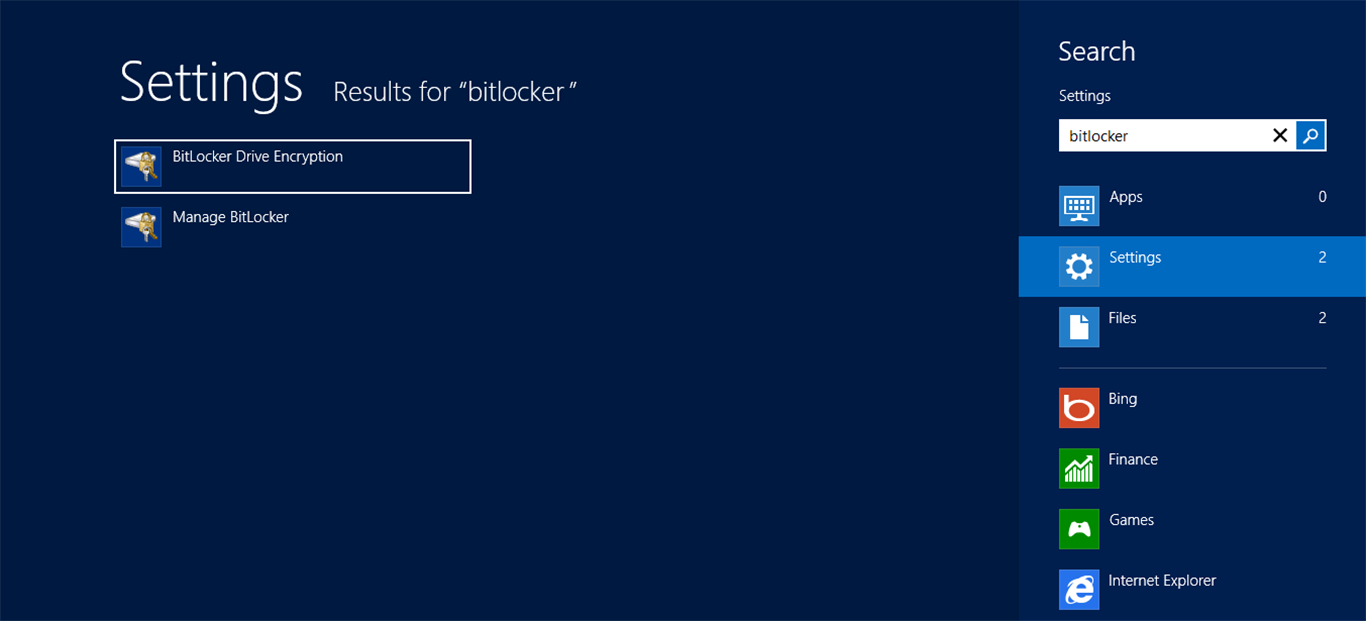
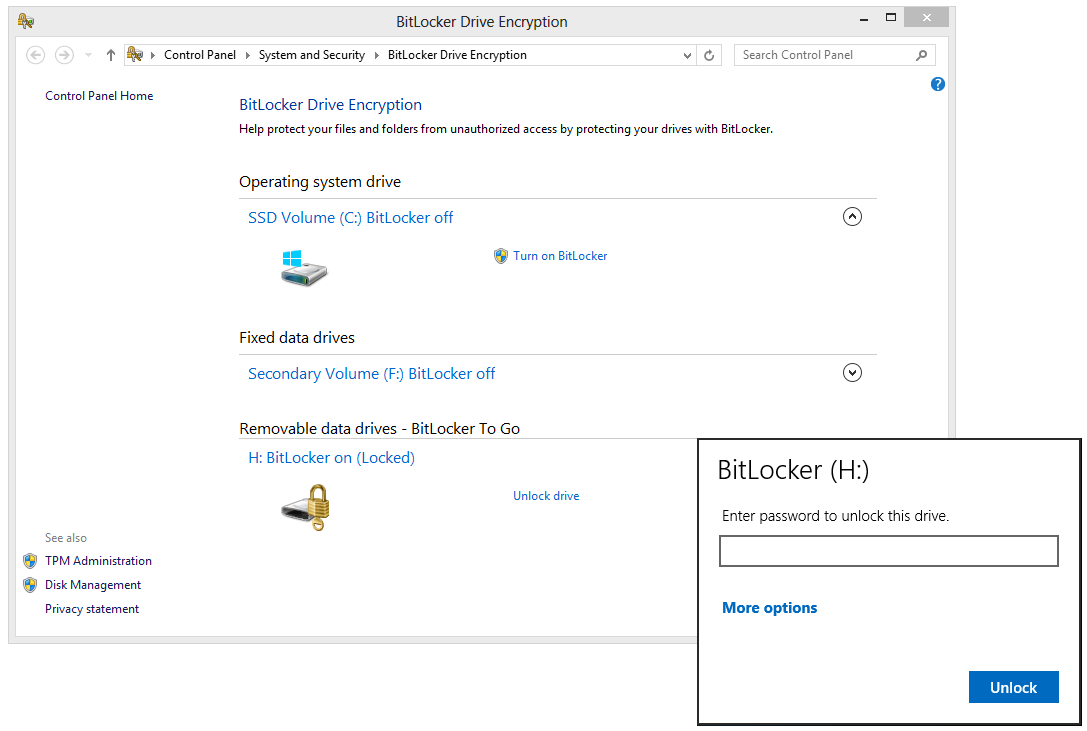
BitLocker To Go can be enabled in the new Windows 8 UI by searching for the feature or via File Explorer while in Desktop mode.
Not only does BitLocker give users the ability to encrypt their OS volume to prevent access to a system and the data stored on it, but a feature called BitLocker To Go (introduced with Windows 7) enables encryption of externally attached portable drives. It uses the same encryption technology, but instead of protecting an OS volume, it’s designed to secure data stored on a portable drive, such as a USB flash or hard-disk drive. And with Windows 8, Microsoft has updated BitLocker To Go with some new features that make it faster and easier to use than ever before.

Using BitLocker To Go on Windows 8

While the lion's share of the new features is meant to reduce headaches for IT professionals managing BitLocker use in business, Microsoft has also sped up the initial drive encryption process. BitLocker To Go, which is available on Windows 8 Professional and Enterprise editions, now has the ability to progressively encrypt only the portions of a drive you're actually using, instead of the entire drive (as was the case with Windows 7). The old method is still available for disks that already contain data, but if you’ve got a fresh, clean drive you’d like to protect with BitLocker To Go, enabling drive encryption can be completed in seconds, not minutes or even hours, depending on the size of the drive. Instead, when you add new data the drive, it will be automatically encrypted while BitLocker To Go is enabled.
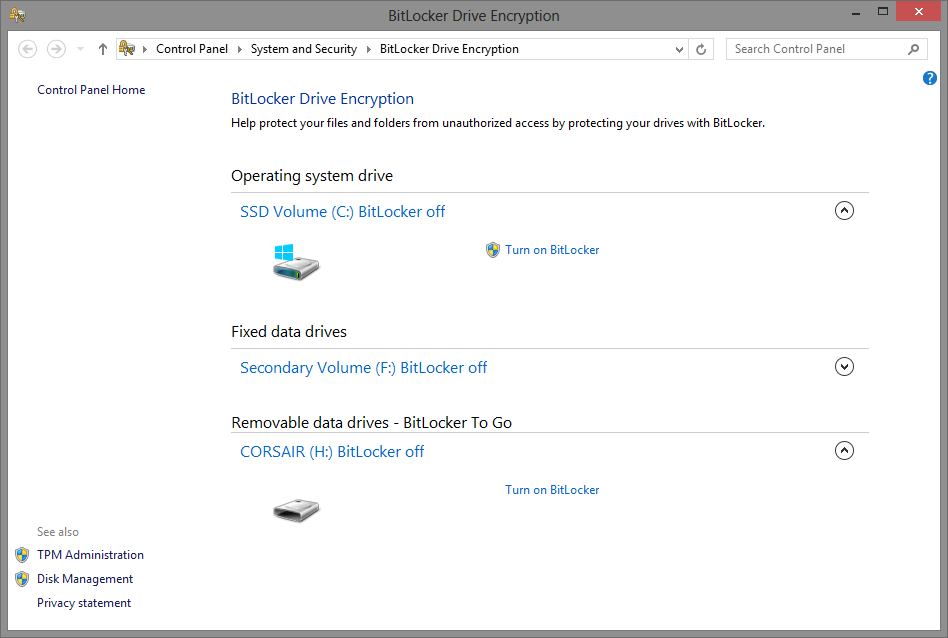
To protect an external drive with BitLocker To Go, first connect the drive to a USB port and wait for Windows to recognize it and assign a drive letter. Switch to Desktop mode, openFile Explorer, right-click on the drive, and choose Turn on BitLocker from the menu. Another way to access BitLocker is to press the + key combination, search for BitLocker, and choose the BitLocker Drive Encryption utility listed in the results under Settings.
When you first select the option to enable BitLocker, a window will open that displays a progress bar (as shown above) while BitLocker loads and scans the drive. This process is usually very quick, but the time will vary depending on the speed of the drive and the system.
Once BitLocker To Go has started and the drive is initialized, you’ll be asked how you want to protect the drive. You’ll have the choice of using either a password or a smart card; for the vast majority of users, the password option will be the only way to go, since smart-card readers are rarely installed on consumer-class computers.
Tick the box labeled Use a password to unlock the drive, and then enter a password in the necessary fields. The password should be something you’ll remember, but use special characters, upper- and lowercase letters, numbers, and symbols to make it as strong as possible. When you've entered the password, click Next.
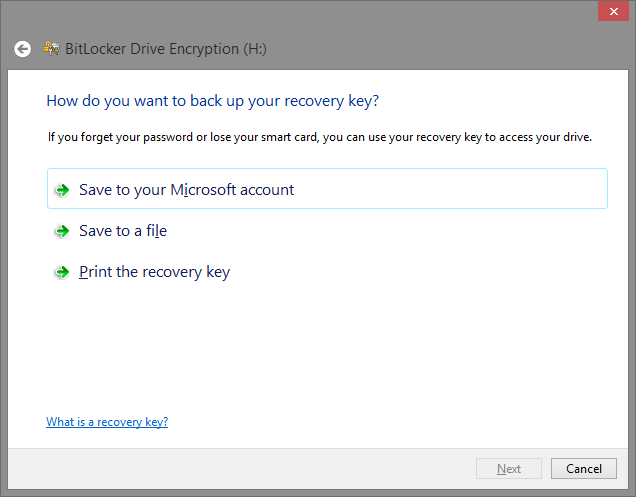
After setting the password, you’ll be prompted to back up a recovery key. Should you forget your password (or lose your smart card), the recovery key can be used to access the protected drive. The recovery key can be saved to a Microsoft account, saved to a file, or printed out. Whatever option you choose, be sure to keep it safe because without it there’s no way to access the drive should you forget the password. Formatting the drive will be the only way you’ll be able to use it again—destroying the data stored on the drive in the process.
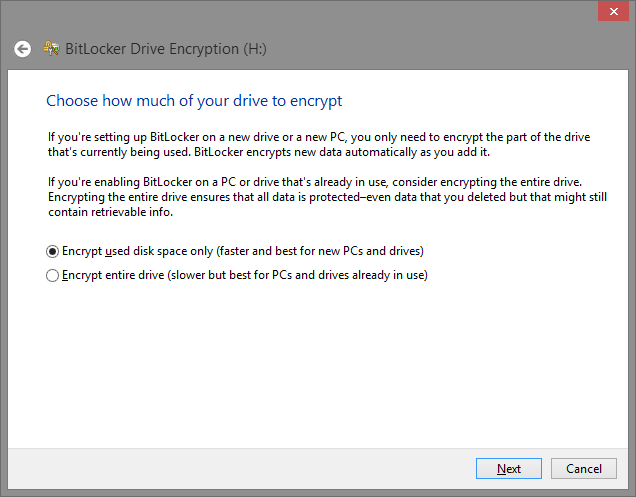
Save the recovery key, click Next, and you’ll be asked how you’d like to encrypt the drive. If it’s a clean drive, select the option to encrypt only the used space to speed up the process. If you're encrypting a drive that’s already filled with data or may have had data deleted from it at some point (data that can still be extracted using recovery or undelete tools), select the option to encrypt the entire drive. The process of encrypting the entire drive can take a very long time (sometimes hours), but every bit of data on the drive will be protected.
After choosing the encryption method, click Next, and you’ll be asked if you’re ready to encrypt the drive. If you’re sure you want to enable BitLocker To Go, just click the Start encrypting button, and the drive will be encrypted. Again, the process may take some time to complete depending on the speed of the drive and the processor in the system. When the encryption process is complete, click Close, and your drive will be protected and ready to use.

Accessing your encrypted drive on the go

When you attach your encrypted drive to a system that supports BitLocker, you’ll be prompted to enter the password before the drive will be accessible. If the correct password is not entered, the drive will appear with a gold padlock over its icon, and you’ll get a "Location not available/Access is denied" error should you try to open it. Enter the correct password, however, and the icon changes to an open padlock; the drive can now be used like any other unprotected drive. The only difference is that data copied to the drive will be encrypted on the fly. If you connnect your encrypted drive to a PC that does not support BitLocker To Go (one running Windows XP/Vista or Mac OS X, for example), it will not be able to read your drive and will probably prompt you to format the device. If you want to access a drive encrypted via BitLocker To Go on a Windows XP or Vista machine you'll need the BitLocker To Go Reader, a program that allows you to open and view the content of removable drives that have been protected (or encrypted) with BitLocker encryption.
Should you miss the opportunity to enter the password when the drive is first inserted, you can also unlock the drive by right-clicking on it in File Explorer and selecting Unlock Drivefrom the menu.
Once the drive is unlocked, you can also access a few additional features offered with BitLocker To Go. Right-click the drive and choose Manage BitLocker from the menu (or search for the BitLocker Drive Encryption utility from the Windows 8 UI as described earlier), and you’ll be able to change the password, add a smart card, enable auto-unlock, or turn off BitLocker entirely, if you so choose.
Read More
Posted in windows 8 | No comments

Six awesome built-in Windows utilities no one knows about

Posted on 5:10 PM by Unknown

Windows 8 may not be the easiest operating system to use, but no one can accuse it of being stingy. If you poke deep inside the new OS, you'll find a generous assortment of software tools, many of which make third-party utilities redundant.
One built-in tool helps you calibrate your PC’s display. Another helps you investigate system-stability problems. And yet another lets you record on-screen actions to create tutorials for Windows applications. All of these utilities are free and come preloaded in Windows 8, with no hidden add-on costs. (You should be aware, though, that the Hyper-V virtual machine manager requires Windows 8 Pro or Enterprise, not the standard version of Windows 8.)
Have we left out any worthy built-in utilities? Read our list, and let us know in the comments section of this article.

Windows reliability history

In the Windows 8 Start screen, type reliability, click Settings, and then select View Reliability History. You’ll go to the Windows desktop, and a window with a timeline will appear. You can also access the Reliability Monitor from the Windows Control Panel, by going to System and Security > Action Center.
You can narrow down dates and specific apps for troubleshooting when you use the reliability history.
The chart is interactive. If you click a column, you’ll see detail text below. In my particular case, the reliability history let me know when my Asus AI Suite stopped working—and, in fact, that one program was the source of many of my Windows 8 app crashes. I have to note that I never once saw an error message when the apps crashed, and when I uninstalled AI Suite, I suffered far fewer stability issues.
Reliability Monitor doesn’t just report problems. It also keeps track of when you’ve installed or updated applications and drivers, so you can pinpoint exact dates and use that knowledge for troubleshooting and system repair. For example, once you know the precise date of a troublesome driver installation, you can roll back your machine via Windows System Restore to a date before that driver started wreaking havoc.

DirectX diagnostics

While I'm on the topic of troubleshooting, let’s take a look at the DirectX Diagnostic Tool, also known as DXDiag. In previous versions of Windows, DXDiag was installed whenever you installed DirectX, which usually occurred when you installed a game. But now that DirectX is part and parcel of the Windows 8 operating system, DXDiag is included from the get-go.
DXDiag gives you detailed information on the state of your DirectX-capable hardware and drivers.
DXDiag pops up a wealth of useful information for evaluating DirectX problems. Under the Display tab, you’ll see the installed GPU, the display interface (DVI, HDMI, or the like), your graphics memory allotment, and so on. The Sound tab gives you information related to the audio device and drivers. DXDiag offers a deeper level of detail than you might find in Device Manager, and it's all specific to DirectX-capable devices.
And, hey, if nothing else, it’s useful if you need to talk to tech support.

Display calibration

Out of the box, your PC monitor is usually too bright, and the colors are typically oversaturated. That may not be an issue if all you do is spreadsheet work, but if you’re editing photos or video, or even just watching movies, you'll want to fine-tune the colors for accuracy.
Sure, you could spend $60 or more for color-calibration software and hardware, and that might be money well spent if you’re a graphics professional or a movie buff who's finicky about faithful color reproduction. But the color-calibration tool built into Windows can give you most of what you need, and you don't have to shell out the cash for additional software.
Checking the color cast of the grayscale settings is just one of the steps in calibrating your display.
Type calibrate into the search box, and select Settings. You want to pick Calibrate Display Color, which is usually the top option. The color calibrator’s welcome screen includes a link to a help-center tutorial. All you really need to do, however, is walk through the steps and read the explanatory text. The first time you do this, don’t skip any of the steps. The steps are, in order: gamma settings, brightness adjustment, contrast adjustment, and color balance. (For more detail, check out “How to Calibrate Your Monitor.”)

Application steps capture

Steps Recorder lets you record each individual step of a particular Windows task. You can't record actions inside a game, but you can capture steps in standard Windows applications this way.
In earlier versions of Windows, this utility was called “Problem Steps Recorder.” Apparently, Microsoft viewed this program mostly as a tool for packaging up user inputs for troubleshooting. The Windows 8 version, however, lets users view the steps and keep a record. To run Steps Recorder, type Steps in the search box, and select Steps Recorder.You’ll get a very simple, small window.
The user interface for Steps Recorder is pretty sparse, and reflects the basic nature of the tool.
Through Steps Recorder you can capture screenshots with every action you perform: each mouse click, key press, and so on. If you’re typing in a text editor (such as Microsoft Word), only the complete text will be shown, not every keystroke. After you stop the recording, you can review what you’ve captured and do simple edits. The tool saves the whole affair in a .zip file, but saves the actual content as an MHTML (Mime HTML) file, which combines different types of content into a single HTML file.
Steps Recorder creates an MHTML file containing screenshots and descriptive text of the Windows user steps it records.
Steps Recorder is no replacement for a sophisticated screen-capture tool such as Camtasia, but it’s useful for quick-and-dirty tutorials when you need to communicate a small set of simple, discrete Windows actions.

Task scheduling

Task Scheduler is just what it sounds like: It helps you set schedules for running specific Windows applications. A typical example might be when you want to schedule a backup to run. However, Task Scheduler also lets you create complex scripts of tasks, which can run in order and at particular times.
For example, Microsoft uses Task Scheduler to set up the daily upload of information on how you use Windows to the Windows Experience team. You run Task Scheduler by typing Schedule, selecting Settings, and then clicking Schedule Tasks.
You can create scripts of tasks, and then run them at specific times, using Task Scheduler.
Some third parties misuse Task Scheduler to load and run apps on startup, when simply tapping into the Startup folder might be a better approach. So even if you don’t plan on ever creating a task script, it’s worthwhile to visit Task Scheduler on occasion to see what applications may have touched it.

Virtual machine creation and management

The Windows 8 Pro and Enterprise versions include the Hyper-V virtual machine manager that was originally built into Windows Server. However, it isn't installed by default. If you want to use Hyper-V, go to the Control Panel, click Programs, and select Turn Windows Features on or off. Choose Hyper-V and click the OK button. After Hyper-V is installed, you’ll need to reboot the PC.
You end up with two applications: Hyper-V (the virtual machine manager that runs the VM software) and the Hyper-V Manager, where you create or remove virtual machines and .VHD (virtual hard drive) files. Once you've created a VM, you can install any OS you want, including Windows 3.1 through Windows 8, Linux, BSD, and others.
Create virtual machines and virtual hard drives using Hyper-V Manager in Windows 8 Pro or Enterprise.
Note that the Windows 8 version leaves out a few features built into the server version, including GPU virtualization (no 3D acceleration in Windows 8 VMs) and some exotic networking features (such as fibre channel support). If you were a user of the Windows XP Mode feature in Windows 7, which used the older Windows Virtual PC, then Hyper-V can fill in the gap. However, unlike with XP Mode, you’ll need a valid Windows XP license key to install Windows XP into a virtual machine.
Read More
Posted in | No comments
Newer Posts Older Posts Home
Subscribe to: Posts (Atom)

Popular Posts

  • The Ubuntu guide for displaced Windows users
    With Windows 8 pushing a “touch-first” desktop interface—Microsoft’s  words , not ours—and with Valve’s  Steam on Linux  beginning to bring ...
  • Backing up your entire drive: Cloning vs. imaging
    Both cloning and imaging create an exact record of your drive or partition. I'm not just talking about the files, but the master boot re...
  • Will Samsung top Apple by withholding revolutionary tech?
    Samsung is drawing closer and closer to the technology that will transform the future of smartphones and  tablets . The company will show of...
  • Obama opposes Silicon Valley firms on immigration reform
    President Obama opposes an immigration reform bill backed by companies including Apple, Microsoft, and Adobe that would let U.S.-educated co...
  • Word vulnerability tops Microsoft's targets for Patch Tuesday
    A flaw in  Microsoft  Word ranks among the top security problems addressed by December's Patch Tuesday fixes, closing a hole that allows...
  • How to make Ubuntu Linux look like Windows 7
    Windows 8's tile-based interface puts a bold new spin on the familiar Windows interface—so bold that many long-time Windows users are th...
  • How to optimize Windows 8 on old hardware (2)
    Disable unnecessary items To further optimize Windows 8 on older hardware, we recommend disabling as many unnecessary startup items and serv...
  • How To Install MacOS On Windows Vista
    If you still think that you need macintosh computer to try MacOS, that's already in the past. Now you can try MacOS on Windows Vista. Ho...
  • Feds: MegaUpload was not entrapped
    Entrapment is one of MegaUpload's claims in its legal battle against the U.S. government. The feds are now saying this claim is "ba...
  • What it really takes to make a flexible phone (Smartphones Unlocked) Read more: http://www.cnet.com/8301-17918_1-57567014-85/what-it-really-takes-to-make-a-flexible-phone-smartphones-unlocked/#ixzz2JqPL5i4n
    A bendable screen is nice in the lab, but it will take more than flexi-glass to get your phone to touch its toes. Had Dr. Dipak Chowdhury kn...

Categories

  • apple
  • browser
  • buy
  • christmas
  • computer information
  • crack
  • cyber monday
  • download
  • files
  • firewall
  • flash disk
  • font
  • graphene
  • hard disk
  • hidden
  • Hot News
  • how to
  • intel
  • Internet
  • Internet Explorer
  • iOS
  • iPad
  • Mac
  • Malware
  • nokia
  • notebook
  • play station 4
  • processor
  • removal
  • safe
  • samsung
  • samsung. microsoft
  • security
  • sony
  • ssd
  • The Meaning Is
  • tips
  • twitter
  • ubuntu
  • video card
  • virus
  • vulnerability
  • What to do
  • windows 8
  • windows7

Blog Archive

  • ▼  2013 (90)
    • ▼  October (2)
      • How to avoid common PC building mistakes
      • Defective RAM can cause all sorts of problems. If ...
    • ►  September (6)
    • ►  August (3)
    • ►  July (4)
    • ►  June (5)
    • ►  May (9)
    • ►  April (14)
    • ►  March (11)
    • ►  February (17)
    • ►  January (19)
  • ►  2012 (27)
    • ►  December (22)
    • ►  November (5)
  • ►  2010 (4)
    • ►  June (1)
    • ►  January (3)
  • ►  2009 (32)
    • ►  December (2)
    • ►  November (11)
    • ►  October (11)
    • ►  September (2)
    • ►  March (2)
    • ►  February (4)
  • ►  2008 (39)
    • ►  October (2)
    • ►  September (2)
    • ►  August (1)
    • ►  June (1)
    • ►  May (3)
    • ►  March (1)
    • ►  February (7)
    • ►  January (22)
  • ►  2007 (46)
    • ►  December (8)
    • ►  November (9)
    • ►  September (4)
    • ►  August (2)
    • ►  July (9)
    • ►  June (14)
Powered by Blogger.

About Me

Unknown
View my complete profile